
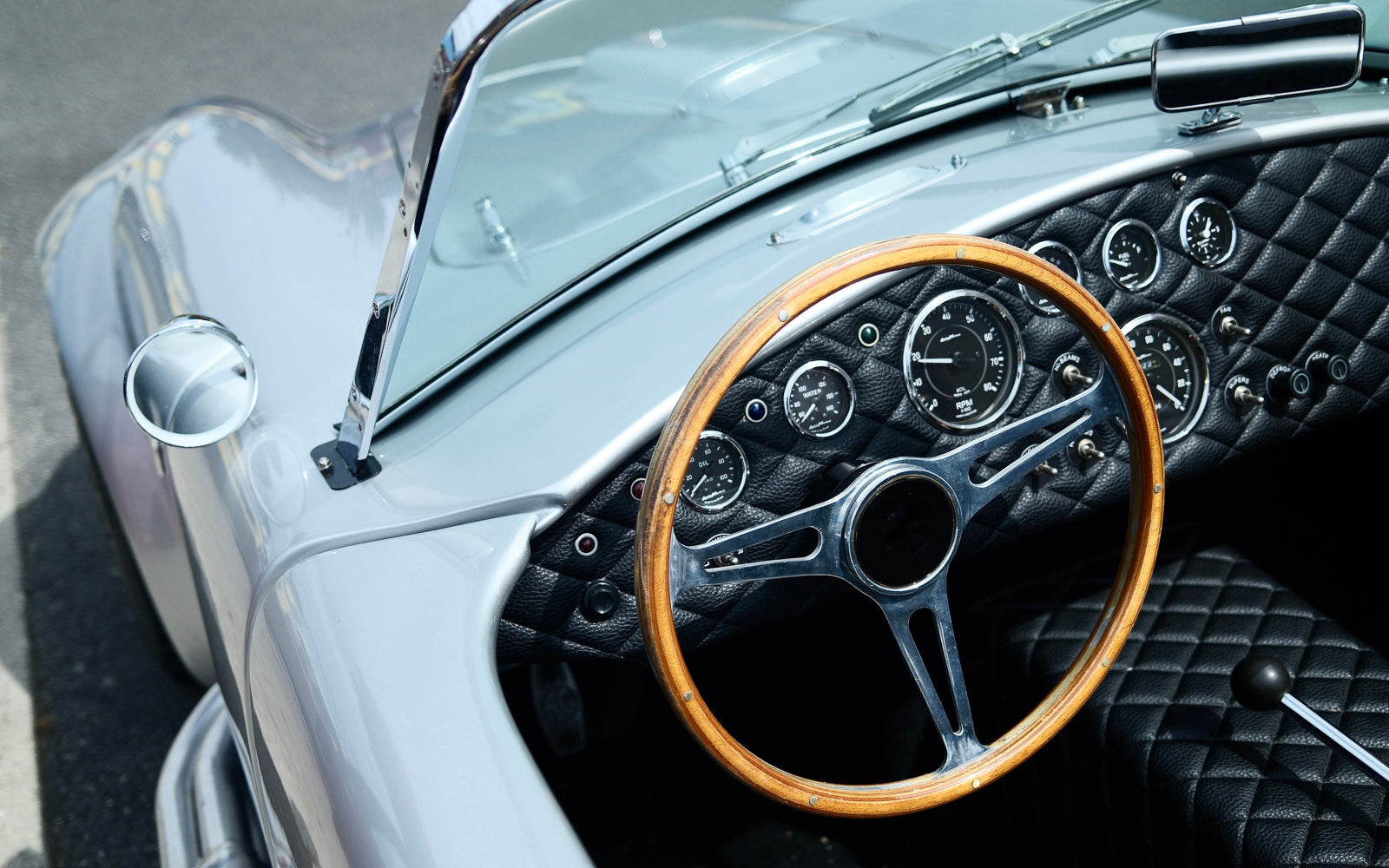
The Analogue Interface
Sit behind the wheel of an older sports car and the first thing you notice is how much it asks of you. A wooden rim worn smooth by hands, a row of analogue dials that must be read rather than alerted to, chrome toggle switches that move with a deliberate weight, a gearshift that demands to be felt. Nothing is automated away. The car does not interpret your intentions; it transmits its condition and leaves the judgement to you. To drive it well is to enter a kind of conversation, and the pleasure lies precisely in the fact that the conversation cannot be skipped.
This is the appeal of the analogue object in a world that has spent decades removing friction from everything. The modern instinct is to smooth the path, to anticipate the need, to reduce the number of decisions a person has to make. There is real value in that for most of life. But there is a category of object the serious collector returns to for the opposite reason, because the friction is the point. The wooden wheel and the mechanical gauge are not inconveniences to be tolerated; they are the means by which the object gives itself fully to the person willing to engage with it.
Single cask whisky belongs to the same category. It is not engineered for consistency or convenience. It is bottled at natural strength, non-chill filtered, individually numbered, and it asks something of the person who opens it: attention, patience, a willingness to read what is in the glass rather than be told. Like the analogue car, it rewards engagement in direct proportion to what is brought to it. The parallel between the two obsessions, the mechanical and the matured, is drawn out at length in the vintage sports car and the single cask.
The objects that ask something of us
There is a thread that connects the things collectors care about most, and it is not price. It is that each one resists being passive. A mechanical watch must be wound and read; it keeps a relationship with its owner that a phone clock does not. A fine cigar must be drawn slowly and attended to or it is wasted. A single cask whisky must be nosed and given time. None of these objects performs for an inattentive owner. They reserve their best for the person who meets them halfway, which is exactly why they hold the attention across a lifetime rather than a season. The shared logic that binds horology and whisky is explored in why the watch you wear and the whisky you collect say the same thing.
It is worth saying plainly why this matters beyond nostalgia. The analogue interface, whether a dashboard or a glass of spirit, preserves the human role in the experience. It keeps the person as a participant rather than a spectator. The pleasure of the wooden wheel is the pleasure of being trusted to drive; the pleasure of the single cask is the pleasure of being trusted to taste. Both are forms of respect from the maker to the owner, an assumption that the person on the other end wants to be involved.
Engagement as the reward
The collector who keeps an analogue car and a cellar of single casks is not being deliberately difficult. They have simply learned that the objects which ask the most also give the most, and that convenience and depth are often in quiet opposition. A whisky met with attention, poured neat in a glass that lets it speak, gives back something a more convenient drink never could. The full place of that attention in the wider enjoyment of the spirit is set out in the rituals that define us.
The wheel, the dial, the gearshift, the glass: each is an interface built to be operated by hand and read by a person paying attention. That is not a limitation. It is an invitation, and the collector is the one who accepts it.
Leave a comment
This site is protected by hCaptcha and the hCaptcha Privacy Policy and Terms of Service apply.