
Why the Glass Matters: How Shape Shapes the Whisky
There is a temptation to think of the glass as incidental, a neutral vessel that holds the whisky and contributes nothing of its own. The serious drinker learns otherwise. The shape of the glass is not packaging around the experience; it is part of the instrument through which the experience arrives. A Single Malt poured into the wrong vessel is not the same whisky poured into the right one, and the difference is not sentiment. It is physics.
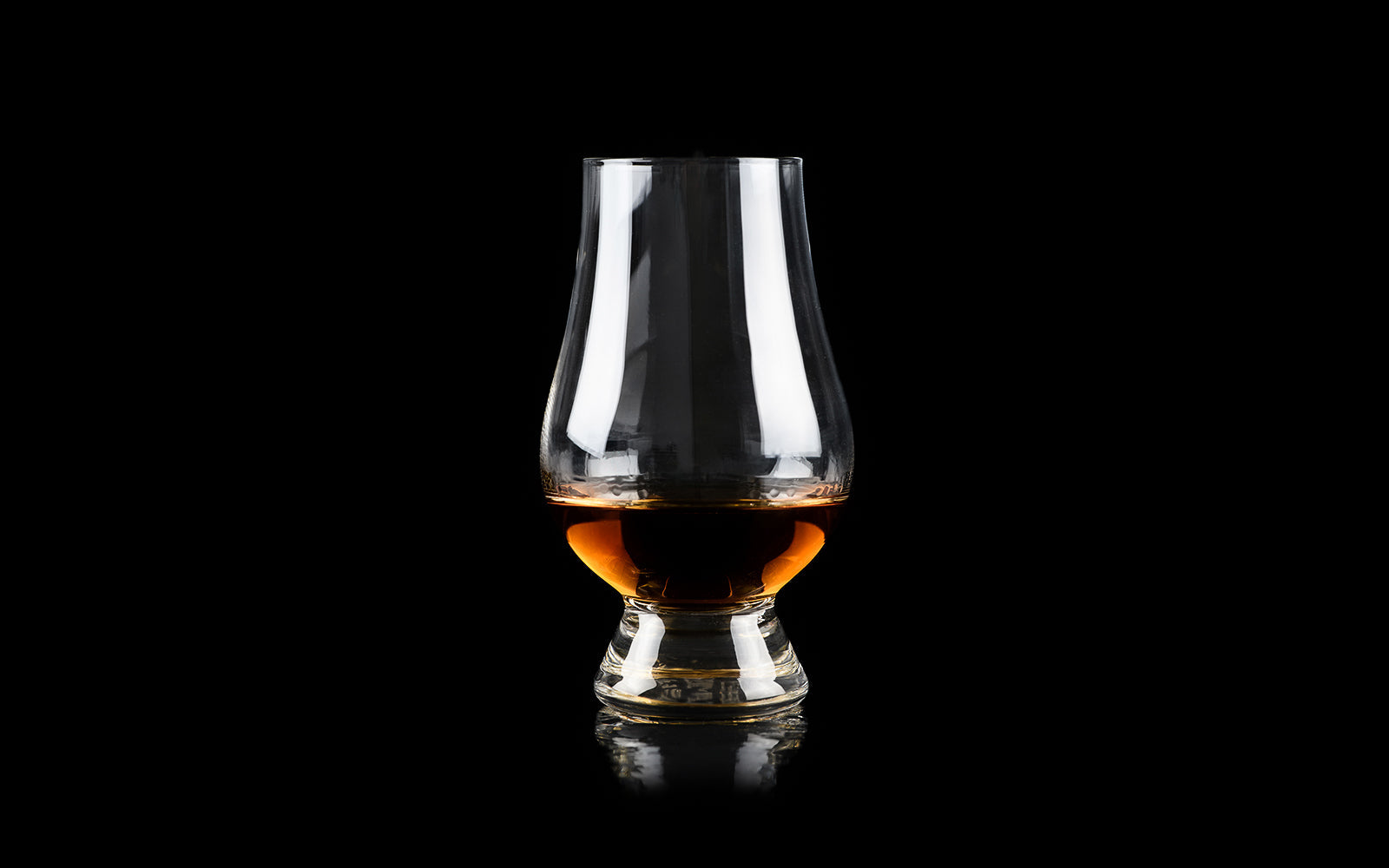
Consider what a whisky actually does in the moment before it is tasted. Aroma carries the overwhelming majority of what we call flavour, and aroma is volatile, rising off the surface of the spirit and dispersing into the air. A wide tumbler lets those volatiles escape in every direction, thinning the nose to almost nothing by the time the glass reaches the face. The tulip form does the opposite. The bowl gives the spirit surface area to release its aromatics, and the narrowing neck gathers them, concentrating the rising vapour into a focused column directed precisely at the nose. Nothing is added. The whisky is simply allowed to present itself fully rather than half of it drifting away across the room.
This is the logic behind the nosing glass, and it is the same logic that governs every well-designed object: form arranged in service of function, so completely that the two become indistinguishable. The stem keeps the warmth of the hand away from the spirit, holding it at the temperature at which it was meant to be read. The clarity of the crystal lets colour be assessed honestly, the depth of amber that tells of cask and time. The weight sits correctly in the hand. None of this is decoration. Each decision exists because it lets the whisky do more of what it is capable of doing.
Design as the completion of the object
The collector understands this instinctively across every field that holds the attention. The case of a fine watch is shaped to protect and to present a movement that most owners will never see running. The humidor is built to hold a single condition of humidity, because the cigar inside is only as good as the air around it. The decanter, the cellar, the presentation box: in each case the secondary object exists to let the primary object reach its full expression. To treat the glass as an afterthought is to accept less of the whisky than was made for you. This is the same conviction that runs through the shape of recognition, where design is understood as identity rather than ornament.
There is a reason the most considered houses extend their attention beyond the bottle. A single cask spirit carries an enormous amount of information, the record of its oak, its years, its strength, the particular character that made it worth bottling alone rather than blending away. To release that information fully requires the right conditions, and the glass is the final and most immediate of them. The engraved Glencairn was chosen for precisely this reason: a tulip bowl that concentrates aroma, a form that has become the standard of the tasting room because it works, presented in a manner that matches the spirit it serves.
How to use it
Pour a modest measure, enough to coat the bowl rather than fill it, so that the surface area does its work and the neck has room to gather. Hold the glass by the stem and let it rest a moment. Bring it to the nose slowly, mouth slightly open, and read what rises before the first sip; the glass will have done most of the work of presenting it. The fuller practice of reading a whisky this way is set out in how to train your palate for Single Malt whisky, and the broader place of glassware in the wider ritual of enjoyment in the rituals that define us.
A whisky worth choosing deliberately deserves to be met with an object chosen as deliberately. The glass is where the spirit and the drinker finally meet, and good design ensures that nothing is lost in the meeting. That is the whole of it: not luxury for its own sake, but the simple insistence that what was made carefully should be received as fully as it was made.
Continue exploring
- The engraved Baroque Glencairn glass
- The Premium Range, single casks worth reading closely
- The Exceptional Cask Collection
- How to train your palate for Single Malt whisky
Leave a comment
This site is protected by hCaptcha and the hCaptcha Privacy Policy and Terms of Service apply.