
How to Train Your Palate for Single Malt Whisky
The palate for Single Malt whisky is not a gift. It is a practice.
This distinction matters because it changes how the serious drinker approaches the development of tasting ability. Sensory acuity, the capacity to identify specific aromatic compounds, to read textural nuance, to articulate what is happening across the nose, palate, and finish of a complex spirit, is not innate. It is built incrementally through consistent, attentive repetition. Every tasting session, approached with genuine focus, adds to a reference library of sensory memory that gradually becomes more precise and more reliable.
Slow down
The first discipline is slowing down. Most people taste whisky far too quickly. The nose is visited briefly, the spirit is consumed immediately, and a general impression of pleasant, rich, smoky or sweet is formed and held. This is drinking, not tasting, and there is nothing wrong with it. But it produces no lasting sensory knowledge. Deliberate palate development begins with spending substantially more time on each phase of the tasting experience before moving to the next.
Nosing
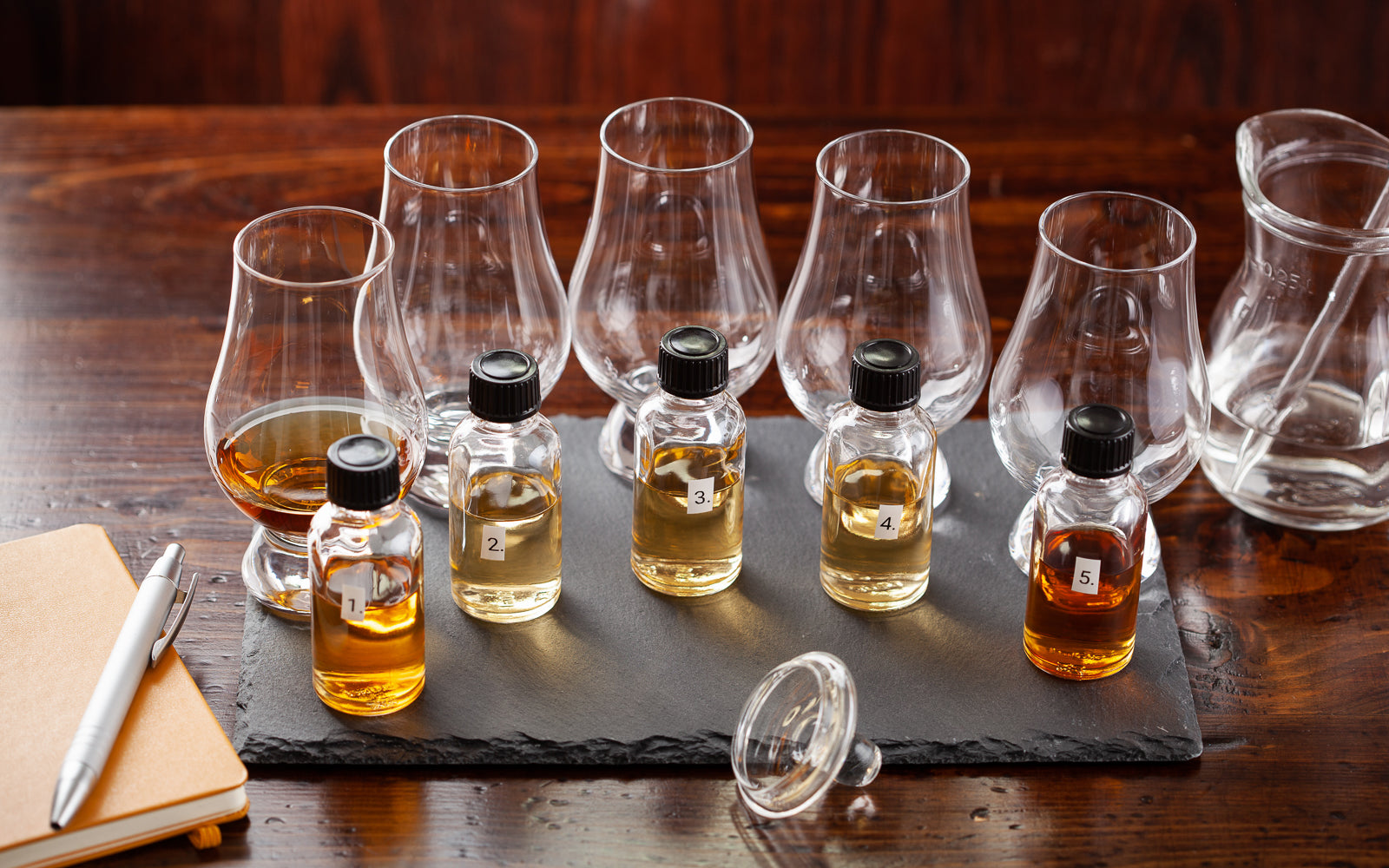
Nosing is where the most information is available and where most casual tasters spend the least time. The Glencairn glass, with its tulip shape concentrating aromatic compounds at the rim, is the correct vessel precisely because it makes this phase more productive. The glass should be held still and the nose brought to it, not the glass raised abruptly to the face. The first impression is often the most honest: before the olfactory system habituates to the dominant aromatics, the full aromatic range is briefly accessible. This passes within seconds. Subsequent nosing sessions with the same glass reveal secondary and tertiary layers as the more volatile compounds dissipate and the deeper structural aromatics become more prominent.
Water as a tool
Adding water is not a concession to strength. It is a technical tool. A small addition of still water, as little as a few drops in a standard dram, reduces surface tension and releases aromatic compounds that are bound at higher alcohol concentrations. Many Single Malts, particularly cask-strength releases, become more expressive and more legible with a modest water addition. The effect is not uniform across all expressions. Some release dramatic aromatic complexity with water; others close slightly. Developing an understanding of how a particular release responds to dilution is itself a form of palate knowledge, and it requires experimentation across multiple tastings of the same spirit.
Reading texture
Texture deserves more attention than it typically receives. Single malt whisky of genuine quality possesses a mouthfeel; a viscosity, a weight on the tongue, a way of coating and releasing that is as informative as its flavour profile. Australian Single Malt matured in first-fill European oak tends to carry substantial textural density: oils and tannins extracted under elevated maturation conditions produce a weight and persistence that lighter-climate whiskies do not replicate. Learning to read this texture, and to distinguish between density that comes from genuine structural development and a heaviness that signals over-extraction or imbalance, is a refinement that comes only from comparative tasting across multiple cask types and maturation styles. A working knowledge of the five cask types every serious collector should know gives that comparison a framework.
Taste comparatively
Comparative tasting accelerates development more than solitary tasting of single expressions. Placing two or three whiskies side by side, ideally with a shared variable and a deliberate point of difference, such as the same base spirit matured in different cask types, forces the palate to articulate contrast. A delicate, aromatic release such as the Single Ex-Botrytis French Oak Cask set against the bright, orchard-fruit lift of the MMXXV Edition III, Meunier Cask is an instructive pairing precisely because both reward close attention rather than rewarding force. The aromatic character that seemed impossible to name in isolation becomes nameable when placed alongside something different. This is how the reference library builds: not through memorising flavour descriptors from tasting notes, but through the direct sensory experience of comparison, repeated consistently over time.
Build the reference library
Memory is the foundation of palate development that is rarely discussed explicitly. The ability to recognise a first-fill ex-Tawny influence, or the specific vanilla and caramel register of American white oak, or the lifted stone-fruit character of French oak maturation, are ultimately acts of memory. The sensory experience of tasting a well-matured ex-Pedro Ximénez Australian Single Malt creates a reference point. Encountering PX influence again in a different release triggers recognition against that reference. Over years of consistent tasting this library deepens, and the taster who once reached for general terms such as dark, rich or sweet begins to reach for more precise ones. Understanding why each cask leaves its particular signature is the subject of The Provenance Question.
At Baroque Whisky, tasting notes accompany every release not as instruction but as one observer's account of what a specific cask yielded at a specific moment of its maturation. The palate that has been developed through patient practice will read those notes differently from one that has not; not accepting them, but placing them in dialogue with its own accumulated reference. That conversation between a thoughtful release and a thoughtful taster is what Single Malt whisky, at its best, is for.
Continue exploring
- The Baroque Glencairn glass, the correct vessel for nosing
- The Premium Range, ideal for comparative tasting across cask types
- The Five Cask Types Every Serious Whisky Collector Should Know
Leave a comment
This site is protected by hCaptcha and the hCaptcha Privacy Policy and Terms of Service apply.