
The Watch Collector's Guide to Building a Whisky Collection
There is a particular kind of collector who already understands everything that matters about whisky before tasting a single drop. They have simply been applying that understanding to something worn on the wrist.
The watch collector and the whisky collector are, in the ways that count, the same person. Both have learned to value the object that rewards attention over the object that demands it. Both have trained themselves to read provenance, to distrust manufactured scarcity, and to recognise the difference between a thing that is rare and a thing that is merely limited. If you have spent years understanding why a movement finished by a single hand carries meaning that a mass-assembled calibre cannot, you already hold the instinct that whisky collecting asks for.
This guide is written for that collector. Not to teach the logic, which you have, but to translate it into a new field.
The shared grammar of provenance
In horology, provenance is everything. A reference number, a service history, the question of whether the dial is original or a later replacement, the lineage of ownership. A watch with documented history commands a multiple of an otherwise identical example without it. The collector knows that what they are buying is not only the object but its verified story.
Single cask whisky operates on the same grammar. The cask is the equivalent of the movement: the source of character, the thing that cannot be replicated. Where a cask came from, what it previously held, how the spirit moved through the wood under a particular climate, these are the variables that decide what ends up in the glass. A single cask release tells you precisely which barrel produced it. An individually numbered bottle tells you precisely where it sits in a finite run. This is the reason a serious whisky behaves, as an object, far more like a watch than like a bottle bought by the case. The question of where a cask came from matters as much as what was in it.
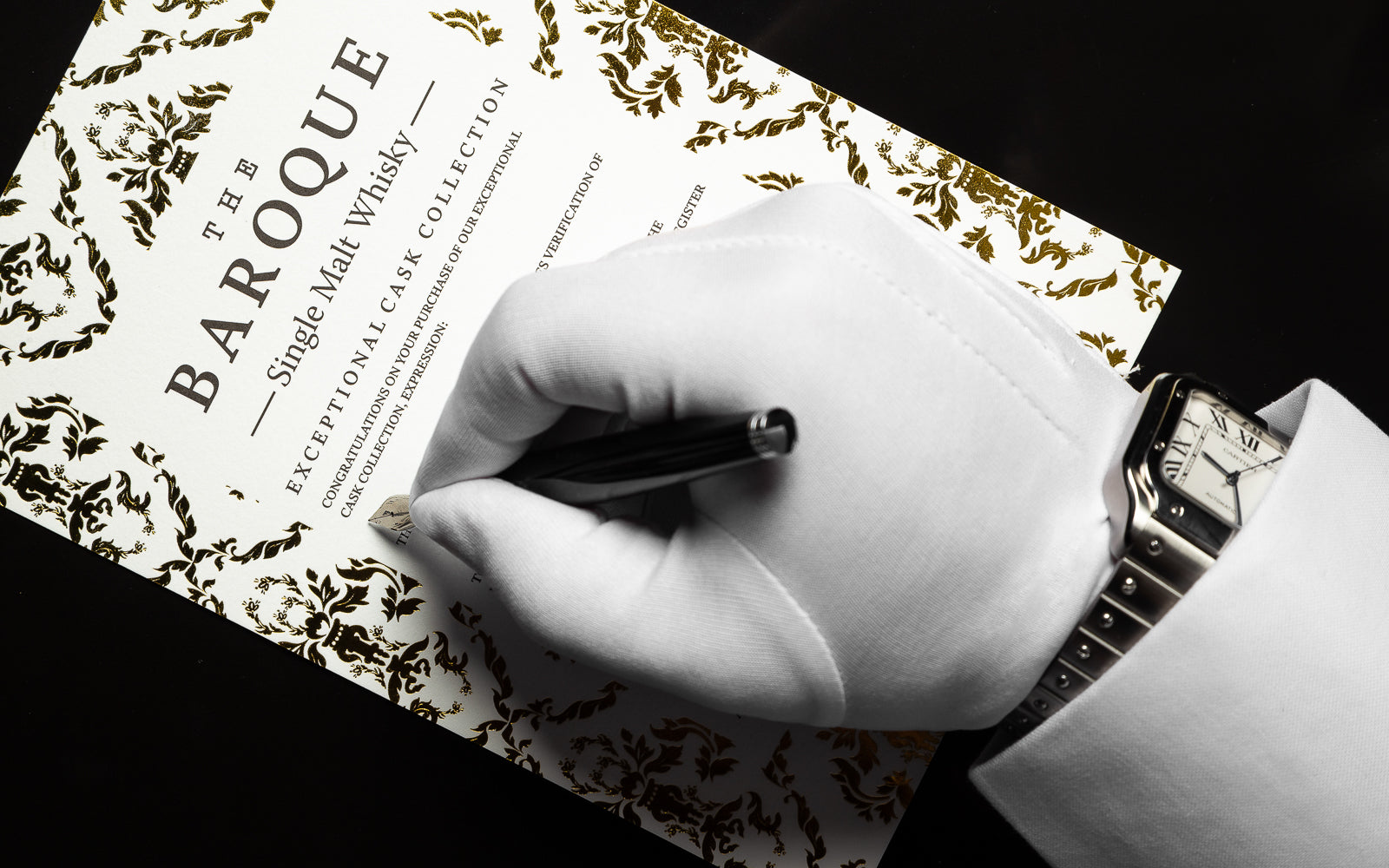
At Baroque, every release records its cask origin and its number. The detail is not decoration. It is the same documentation a watch collector expects, applied to a different material.
Scarcity that means something
Every collector learns, often expensively, to separate genuine scarcity from the engineered kind. A limited edition of ten thousand is a marketing number. A run constrained by the physical reality of a single cask is a fact.
Whisky has an honesty here that even watches cannot match. A single cask yields a finite number of bottles and no more, because the liquid simply runs out. The Australian climate compounds this: warmer maturation accelerates the exchange between spirit and oak and increases evaporation, the portion lost to the air. The result is a smaller yield and a more concentrated whisky. Scarcity, in other words, is a by-product of how the whisky is made, not a decision made afterward.
Patience as the discipline
The watch collector understands waiting. Allocation lists, the years between ordering and receiving, the patience that the most desirable pieces demand as a condition of entry. This is not an inconvenience to be tolerated. It is part of what signals that the object is worth having.
Whisky asks for the same temperament, in two forms. The first is maturation itself, the years the spirit spends in oak before anyone tastes it, time that cannot be hurried. The second is acquisition. The most considered releases move through allocation rather than open shelves, which means the collector who wants them learns to register early and wait.
Where to begin
A watch collector building a first whisky collection should resist the urge to acquire broadly. The same principle that governs a watch collection governs a whisky one: depth over breadth, a few significant pieces understood well rather than many held shallowly.
Begin with cask diversity rather than brand diversity. A first-fill ex-Bourbon American oak release teaches you what vanilla, oak structure and clean sweetness express in the glass. A first-fill ex-Pedro Ximenez Spanish oak release teaches you density, dried fruit and the weight a sherry-seasoned cask imparts. An ex-Botrytis French oak release teaches you what a rare dessert wine cask contributes. Three casks, three lessons, and the beginning of a trained palate. Our guide to the five cask types every serious collector should know sets out the rest.
From there, the parallel to horology completes itself. As a watch collection eventually reaches toward the grail piece, a whisky collection reaches toward the archival release held not to be opened soon but to be owned, understood, and in time perhaps passed on. Our notes on building a private whisky cellar place this in context.
The same obsession, a different object
What unites the two disciplines is not the objects but the temperament of the people who pursue them. The willingness to learn deeply. The refusal to mistake the loud for the valuable. The patience to wait, and the discipline to hold. This is the same argument we make in why the watch you wear and the whisky you collect say the same thing.
If that describes how you have built your watch collection, you will find whisky collecting not a new hobby but the same one, conducted in a different material. The grammar is already yours.
Continue exploring
- The Exceptional Cask Collection, finite, individually numbered single casks
- The Premium Range
- Objects that outlive their makers
- The architecture of trust
Leave a comment
This site is protected by hCaptcha and the hCaptcha Privacy Policy and Terms of Service apply.